LoRa Examples
The following tutorials demonstrate the use of the LoRa functionality. LoRa can work in 2 different modes: LoRa-MAC (which we also call Raw-LoRa) and LoRaWAN mode.
When using LoRa, always connect the appropriate LoRa antenna to your device. See the figure below for the correct antenna placement.
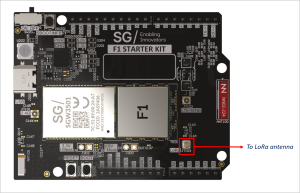
F1 Starter Kit
Note
A standalone pluggable LoRa antenna in u.FL connector type is included in the F1 Starter Kit.
LoRaWAN mode implements the full LoRaWAN stack for a class A device. It supports both OTAA and ABP connection methods, as well as advanced features like adding and removing custom channels to support “special” frequency plans like those used in New Zealand. There are two basic ways of accessing the LoRaWAN network:
Note
When using LoRaWAN, first register with one of the networks.
LoRa-MAC mode basically accesses the radio directly and packets are sent using the LoRa modulation on the selected frequency without any headers, addressing information or encryption. Only a CRC is added at the tail of the packet and this is removed before the received frame is passed on to the application. This mode can be used to build any higher level protocol that can benefit from the long range features of the LoRa modulation.
LoRaWAN with OTAA
OTAA stands for Over The Air Authentication. With this method the device sends a
Join request to the LoRaWAN Gateway using the app_eui and app_key provided
in your LoRaWAN application (like TheThingsNetwork, Chirpstack etc.). If the keys
are correct the Gateway will reply with a join accept message and from that point
on the device is able to send and receive packets to/from the Gateway. If the keys
are incorrect no response will be received and the has_joined() method will always
return False.
The example below attempts to get any data received after sending the frame. Keep in mind that the Gateway might not be sending any data back, therefore we make the socket non-blocking before attempting to receive, in order to prevent getting stuck waiting for a packet that will never arrive.
If everything works correctly, the device will print Joined to the terminal, and
you should see a data packet arrive in your LoRaWAN application containing
0x01 0x02 0x03.
Note
If the dev_eui is not provided, the LoRa MAC of the device will be used in
its place. You will need to change the dev_eui in your LoRaWAN application
to the LoRa MAC address of the device. You can get the LoRa MAC using:
from network import LoRa
import binascii
print(binascii.hexlify(LoRa().mac()).upper())
Note
US915 / AU915 regions: Most LoRaWAN gateways are configured to listen to
8 channels only, while the region supports up to 64 uplink channels. In order to
receive packets, please confirm the frequency plan of your gateway with the channels
configured on your device. By default, our devices will transmit on all 64 channels,
meaning you might receive packets intermittently. The most common configuration is
FSB2, or channels 8-15. Uncomment the respective section in the example below
to select these uplink channels.
For LoRaWAN v1.0.x:
# ---------------------------------------------------------------------------- #
# Copyright (c) 2023-2024 SG Wireless - All Rights Reserved
#
# Permission is hereby granted, free of charge, to any person obtaining a copy
# of this software and associated documentation files(the "Software"), to deal
# in the Software without restriction, including without limitation the rights
# to use,  copy,  modify,  merge, publish, distribute, sublicense, and/or sell
# copies  of  the  Software,  and  to  permit  persons to whom the Software is
# furnished to do so, subject to the following conditions:
#
# The above copyright notice and this permission notice shall be included in
# all copies or substantial portions of the Software.
#
# THE SOFTWARE IS PROVIDED "AS IS",  WITHOUT WARRANTY OF ANY KIND,  EXPRESS OR
# IMPLIED,  INCLUDING BUT NOT LIMITED TO  THE  WARRANTIES  OF  MERCHANTABILITY
# FITNESS FOR A PARTICULAR PURPOSE AND NONINFRINGEMENT.  IN NO EVENT SHALL THE
# AUTHORS  OR  COPYRIGHT  HOLDERS  BE  LIABLE FOR ANY CLAIM,  DAMAGES OR OTHER
# LIABILITY, WHETHER IN AN ACTION OF CONTRACT, TORT OR OTHERWISE, ARISING FROM,
# OUT OF OR IN  CONNECTION WITH  THE SOFTWARE OR  THE USE OR OTHER DEALINGS IN
# THE SOFTWARE.
#
# Desc      Implements simple lora OTAA activation.
# ---------------------------------------------------------------------------- #

# required imports
import logs         # for system logging management
import lora         # for lora-stack
import ubinascii    # for hex/string conversions
import time         # for time manipulation

# disable fw logs
logs.filter_subsystem('lora', False)

# switch to lora-wan if not
lora.mode(lora._mode.WAN)

# configure the stack on region EU-868
lora.wan_params(region=lora._region.REGION_EU868, lwclass=lora._class.CLASS_A)

# start end-device commissioning
lora.commission(
    type    = lora._commission.OTAA,
    version = lora._version.VERSION_1_0_X,
    DevEUI  = ubinascii.unhexlify('0000000000000000'),
    JoinEUI = ubinascii.unhexlify('0000000000000000'),
    AppKey  = ubinascii.unhexlify('00000000000000000000000000000000')
    )

# start join procedure
lora.join()

# wait until join
while lora.is_joined() == False:
    print("wait joining ...")
    time.sleep(2)
    pass
print("-- JOINED --")
lora.stats()

# open a working port
lora.port_open(1)

# attach required callback
# the handler takes a single context dict: 'event' is always present, and
# the rest of the keys depend on the event -- 'data', 'RSSI', 'SNR', 'port',
# 'DR' and 'dl_frame_counter' on a receive, 'msg_id' on a tx outcome.
def lora_callback(context):
    def get_class_const_name(__class, __const):
        for k,v in __class.__dict__.items():
            if v == __const:
                return k
        return 'unknown'
    print('lora event: {} with-context: {}'.format(
        get_class_const_name(lora._event, context['event']), context))
    pass

lora.callback( handler = lora_callback )

# start duty cycle
lora.duty_set(10000)
lora.enable_rx_listening()
lora.duty_start()

# schedule sending some test messages
i = 1000
while i < 1010:
    lora.send('tx-message-with-id-{}'.format(i), port=1, confirm=True, id = i)
    i = i + 1

# --- end of file ------------------------------------------------------------ #
For LoRaWAN v1.1.x:
# ---------------------------------------------------------------------------- #
# Copyright (c) 2023-2024 SG Wireless - All Rights Reserved
#
# Permission is hereby granted, free of charge, to any person obtaining a copy
# of this software and associated documentation files(the "Software"), to deal
# in the Software without restriction, including without limitation the rights
# to use,  copy,  modify,  merge, publish, distribute, sublicense, and/or sell
# copies  of  the  Software,  and  to  permit  persons to whom the Software is
# furnished to do so, subject to the following conditions:
#
# The above copyright notice and this permission notice shall be included in
# all copies or substantial portions of the Software.
#
# THE SOFTWARE IS PROVIDED "AS IS",  WITHOUT WARRANTY OF ANY KIND,  EXPRESS OR
# IMPLIED,  INCLUDING BUT NOT LIMITED TO  THE  WARRANTIES  OF  MERCHANTABILITY
# FITNESS FOR A PARTICULAR PURPOSE AND NONINFRINGEMENT.  IN NO EVENT SHALL THE
# AUTHORS  OR  COPYRIGHT  HOLDERS  BE  LIABLE FOR ANY CLAIM,  DAMAGES OR OTHER
# LIABILITY, WHETHER IN AN ACTION OF CONTRACT, TORT OR OTHERWISE, ARISING FROM,
# OUT OF OR IN  CONNECTION WITH  THE SOFTWARE OR  THE USE OR OTHER DEALINGS IN
# THE SOFTWARE.
#
# Desc      Implements simple lora OTAA activation.
# ---------------------------------------------------------------------------- #

# required imports
import logs         # for system logging management
import lora         # for lora-stack
import ubinascii    # for hex/string conversions
import time         # for time manipulation

# disable fw logs
logs.filter_subsystem('lora', False)

# switch to lora-wan if not
lora.mode(lora._mode.WAN)

# configure the stack on region EU-868
lora.wan_params(region=lora._region.REGION_EU868, lwclass=lora._class.CLASS_A)

# start end-device commissioning
# for DevEUI, AppKey and NwkKey, please replace zeros with your specific
# device information
lora.commission(
    type    = lora._commission.OTAA,
    version = lora._version.VERSION_1_1_X,
    DevEUI  = ubinascii.unhexlify('0000000000000000'),
    JoinEUI = ubinascii.unhexlify('0000000000000000'),
    AppKey  = ubinascii.unhexlify('00000000000000000000000000000000'),
    NwkKey  = ubinascii.unhexlify('00000000000000000000000000000000')
    )

# start join procedure
lora.join()

# wait until join
while lora.is_joined() == False:
    print("wait joining ...")
    time.sleep(2)
    pass
print("-- JOINED --")
lora.stats()

# open a working port
lora.port_open(1)

# attach required callback
# the handler takes a single context dict: 'event' is always present, and
# the rest of the keys depend on the event -- 'data', 'RSSI', 'SNR', 'port',
# 'DR' and 'dl_frame_counter' on a receive, 'msg_id' on a tx outcome.
def lora_callback(context):
    def get_class_const_name(__class, __const):
        for k,v in __class.__dict__.items():
            if v == __const:
                return k
        return 'unknown'
    print('lora event: {} with-context: {}'.format(
        get_class_const_name(lora._event, context['event']), context))
    pass

lora.callback( handler = lora_callback )

# start duty cycle
lora.duty_set(10000)
lora.enable_rx_listening()
lora.duty_start()

# schedule sending some test messages
i = 1000
while i < 1010:
    lora.send('tx-message-with-id-{}'.format(i), port=1, confirm=True, id = i)
    i = i + 1

# --- end of file ------------------------------------------------------------ #
LoRaWAN with ABP
ABP stands for Authentication By Personalization. It means that the encryption keys are configured manually on the device and can start sending frames to the Gateway without needing a ‘handshake’ procedure to exchange the keys (such as the one performed during an OTAA join procedure).
The example below attempts to get any data received after sending the frame. Keep in mind that the Gateway might not be sending any data back, therefore we make the socket non-blocking before attempting to receive, in order to prevent getting stuck waiting for a packet that will never arrive.
Note
US915 / AU915 regions: Most LoRaWAN gateways are configured to listen to
8 channels only, while the region supports up to 64 uplink channels. In order to
receive packets, please confirm the frequency plan of your gateway with the channels
configured on your device. By default, our devices will transmit on all 64 channels,
meaning you might receive packets intermittently. The most common configuration is
FSB2, or channels 8-15. Uncomment the respective section in the example below
to select these uplink channels.
For LoRaWAN v1.0.x:
# ---------------------------------------------------------------------------- #
# Copyright (c) 2023-2024 SG Wireless - All Rights Reserved
#
# Permission is hereby granted, free of charge, to any person obtaining a copy
# of this software and associated documentation files(the "Software"), to deal
# in the Software without restriction, including without limitation the rights
# to use,  copy,  modify,  merge, publish, distribute, sublicense, and/or sell
# copies  of  the  Software,  and  to  permit  persons to whom the Software is
# furnished to do so, subject to the following conditions:
#
# The above copyright notice and this permission notice shall be included in
# all copies or substantial portions of the Software.
#
# THE SOFTWARE IS PROVIDED "AS IS",  WITHOUT WARRANTY OF ANY KIND,  EXPRESS OR
# IMPLIED,  INCLUDING BUT NOT LIMITED TO  THE  WARRANTIES  OF  MERCHANTABILITY
# FITNESS FOR A PARTICULAR PURPOSE AND NONINFRINGEMENT.  IN NO EVENT SHALL THE
# AUTHORS  OR  COPYRIGHT  HOLDERS  BE  LIABLE FOR ANY CLAIM,  DAMAGES OR OTHER
# LIABILITY, WHETHER IN AN ACTION OF CONTRACT, TORT OR OTHERWISE, ARISING FROM,
# OUT OF OR IN  CONNECTION WITH  THE SOFTWARE OR  THE USE OR OTHER DEALINGS IN
# THE SOFTWARE.
#
# Desc      Implements simple lora ABP activation.
# ---------------------------------------------------------------------------- #

# required imports
import logs         # for system logging management
import lora         # for lora-stack
import ubinascii    # for hex/string conversions
import time         # for time manipulation

# disable fw logs
logs.filter_subsystem('lora', False)

# switch to lora-wan if not
lora.mode(lora._mode.WAN)

# configure the stack on region EU-868
lora.wan_params(region=lora._region.REGION_EU868, lwclass=lora._class.CLASS_A)

# start end-device commissioning
lora.commission(
    type    = lora._commission.ABP,
    version = lora._version.VERSION_1_0_X,
    DevAddr = 0x00000000,
    DevEUI  = ubinascii.unhexlify('0000000000000000'),
    AppSKey = ubinascii.unhexlify('00000000000000000000000000000000'),
    NwkSKey = ubinascii.unhexlify('00000000000000000000000000000000')
    )

# start join procedure
lora.join()

# wait until join
while lora.is_joined() == False:
    print("wait joining ...")
    time.sleep(2)
    pass
print("-- JOINED --")
lora.stats()

# open a working port
lora.port_open(1)

# attach required callback
# the handler takes a single context dict: 'event' is always present, and
# the rest of the keys depend on the event -- 'data', 'RSSI', 'SNR', 'port',
# 'DR' and 'dl_frame_counter' on a receive, 'msg_id' on a tx outcome.
def lora_callback(context):
    def get_class_const_name(__class, __const):
        for k,v in __class.__dict__.items():
            if v == __const:
                return k
        return 'unknown'
    print('lora event: {} with-context: {}'.format(
        get_class_const_name(lora._event, context['event']), context))
    pass

lora.callback( handler = lora_callback )

# start duty cycle
lora.duty_set(10000)
lora.enable_rx_listening()
lora.duty_start()

# schedule sending some test messages
i = 1000
while i < 1010:
    lora.send('tx-message-with-id-{}'.format(i), port=1, confirm=True, id = i)
    i = i + 1

# --- end of file ------------------------------------------------------------ #
For LoRaWAN v1.1.x:
# ---------------------------------------------------------------------------- #
# Copyright (c) 2023-2024 SG Wireless - All Rights Reserved
#
# Permission is hereby granted, free of charge, to any person obtaining a copy
# of this software and associated documentation files(the "Software"), to deal
# in the Software without restriction, including without limitation the rights
# to use,  copy,  modify,  merge, publish, distribute, sublicense, and/or sell
# copies  of  the  Software,  and  to  permit  persons to whom the Software is
# furnished to do so, subject to the following conditions:
#
# The above copyright notice and this permission notice shall be included in
# all copies or substantial portions of the Software.
#
# THE SOFTWARE IS PROVIDED "AS IS",  WITHOUT WARRANTY OF ANY KIND,  EXPRESS OR
# IMPLIED,  INCLUDING BUT NOT LIMITED TO  THE  WARRANTIES  OF  MERCHANTABILITY
# FITNESS FOR A PARTICULAR PURPOSE AND NONINFRINGEMENT.  IN NO EVENT SHALL THE
# AUTHORS  OR  COPYRIGHT  HOLDERS  BE  LIABLE FOR ANY CLAIM,  DAMAGES OR OTHER
# LIABILITY, WHETHER IN AN ACTION OF CONTRACT, TORT OR OTHERWISE, ARISING FROM,
# OUT OF OR IN  CONNECTION WITH  THE SOFTWARE OR  THE USE OR OTHER DEALINGS IN
# THE SOFTWARE.
#
# Desc      Implements simple lora ABP activation.
# ---------------------------------------------------------------------------- #

# required imports
import logs         # for system logging management
import lora         # for lora-stack
import ubinascii    # for hex/string conversions
import time         # for time manipulation

# disable fw logs
logs.filter_subsystem('lora', False)

# switch to lora-wan if not
lora.mode(lora._mode.WAN)

# configure the stack on region EU-868
lora.wan_params(region=lora._region.REGION_EU868, lwclass=lora._class.CLASS_A)

# start end-device commissioning
lora.commission(
    type    = lora._commission.ABP,
    version = lora._version.VERSION_1_1_X,
    DevAddr = 0x00000000,
    DevEUI  = ubinascii.unhexlify('0000000000000000'),
    AppSKey = ubinascii.unhexlify('00000000000000000000000000000000'),
    NwkSKey = ubinascii.unhexlify('00000000000000000000000000000000')
    )

# start join procedure
lora.join()

# wait until join
while lora.is_joined() == False:
    print("wait joining ...")
    time.sleep(2)
    pass
print("-- JOINED --")
lora.stats()

# open a working port
lora.port_open(1)

# attach required callback
# the handler takes a single context dict: 'event' is always present, and
# the rest of the keys depend on the event -- 'data', 'RSSI', 'SNR', 'port',
# 'DR' and 'dl_frame_counter' on a receive, 'msg_id' on a tx outcome.
def lora_callback(context):
    def get_class_const_name(__class, __const):
        for k,v in __class.__dict__.items():
            if v == __const:
                return k
        return 'unknown'
    print('lora event: {} with-context: {}'.format(
        get_class_const_name(lora._event, context['event']), context))
    pass

lora.callback( handler = lora_callback )

# start duty cycle
lora.duty_set(10000)
lora.enable_rx_listening()
lora.duty_start()

# schedule sending some test messages
i = 1000
while i < 1010:
    lora.send('tx-message-with-id-{}'.format(i), port=1, confirm=True, id = i)
    i = i + 1

# --- end of file ------------------------------------------------------------ #
LoRa-MAC (Raw LoRa)
Basic LoRa connection example, sending and receiving data. In LoRa-MAC mode the LoRaWAN layer is bypassed and the radio is used directly. The data sent is not formatted or encrypted in any way, and no addressing information is added to the frame.
For the example below, you will need two F1 starter kits. Run the code below on the two F1 starter kits, you will see the word ‘Hello from LoRa chat’ being received on both sides.
# ---------------------------------------------------------------------------- #
# Copyright (c) 2023-2024 SG Wireless - All Rights Reserved
#
# Permission is hereby granted, free of charge, to any person obtaining a copy
# of this software and associated documentation files(the "Software"), to deal
# in the Software without restriction, including without limitation the rights
# to use,  copy,  modify,  merge, publish, distribute, sublicense, and/or sell
# copies  of  the  Software,  and  to  permit  persons to whom the Software is
# furnished to do so, subject to the following conditions:
#
# The above copyright notice and this permission notice shall be included in
# all copies or substantial portions of the Software.
#
# THE SOFTWARE IS PROVIDED "AS IS",  WITHOUT WARRANTY OF ANY KIND,  EXPRESS OR
# IMPLIED,  INCLUDING BUT NOT LIMITED TO  THE  WARRANTIES  OF  MERCHANTABILITY
# FITNESS FOR A PARTICULAR PURPOSE AND NONINFRINGEMENT.  IN NO EVENT SHALL THE
# AUTHORS  OR  COPYRIGHT  HOLDERS  BE  LIABLE FOR ANY CLAIM,  DAMAGES OR OTHER
# LIABILITY, WHETHER IN AN ACTION OF CONTRACT, TORT OR OTHERWISE, ARISING FROM,
# OUT OF OR IN  CONNECTION WITH  THE SOFTWARE OR  THE USE OR OTHER DEALINGS IN
# THE SOFTWARE.
#
# Desc      Implements simple lora chat demo for the lora-raw mode
#           should be run on two different devices.
# ---------------------------------------------------------------------------- #

# disable logs
import logs
logs.filter_subsystem('lora', False)

# import the responsible module
import lora

# switch to lora raw if not there
if lora.mode() != lora._mode.RAW:
    lora.mode(lora._mode.RAW)

# define the callback
def lora_callback(context):
    if context['event'] == lora._event.EVENT_RX_DONE:
        print(context['data'])
    pass
lora.callback(handler=lora_callback)

# start continuous reception
lora.recv_cont_start()

# start chatting by sending
lora.send('Hello from LoRa chat')

# --- end of file ------------------------------------------------------------ #